Coastal zamia
![[Translate to English:] Kyst-zamia (Zamia poeppigiana) i Væksthusene i Aarhus](/fileadmin/_processed_/5/9/csm_Kyst-zamia2-1920x1080_94c8f68ab7.jpg "[Translate to English:] Kyst-zamia")
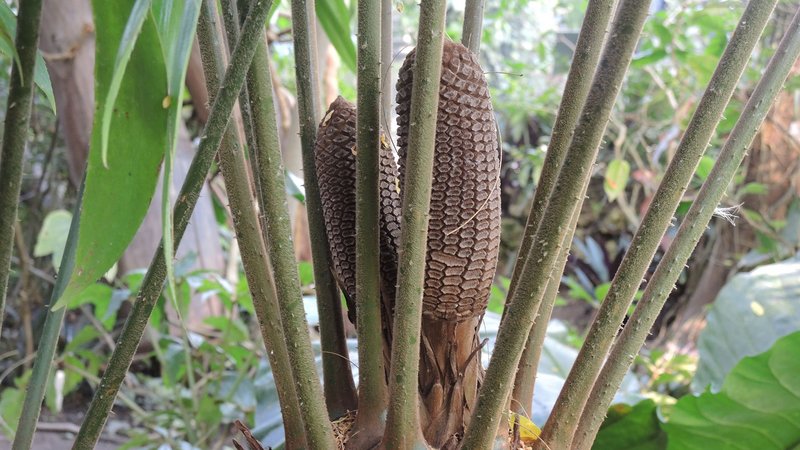
Coastal zamia belongs to an ancient group of plants that has existed on Earth for around 300 million years and was already present long before the first dinosaurs appeared about 230 million years ago.
In appearance, the plant resembles a palm, but it does not produce flowers and is in fact more closely related to conifers.
Cycads are either male or female plants. The coastal zamia in the greenhouses is a female plant, but since we do not have a male plant, it cannot produce seeds. And that may be just as well, because the seeds have a strong smell of butyric acid – a bit like sour feet!
There are around 250 species of cycads worldwide. Most grow in tropical regions, and many are today threatened with extinction in the wild.
Facts:
- Greenhouse location: Tropical house
- Danish name: Kyst-zamia
- Latin name: Zamia poeppigiana
- Family: Cycad family / Zamiaceae
- Natural habitat: Costal rainforest in Ecuador and Peru
Learn more about other plants here.