Marcgravia

© Egon Krogsgaard
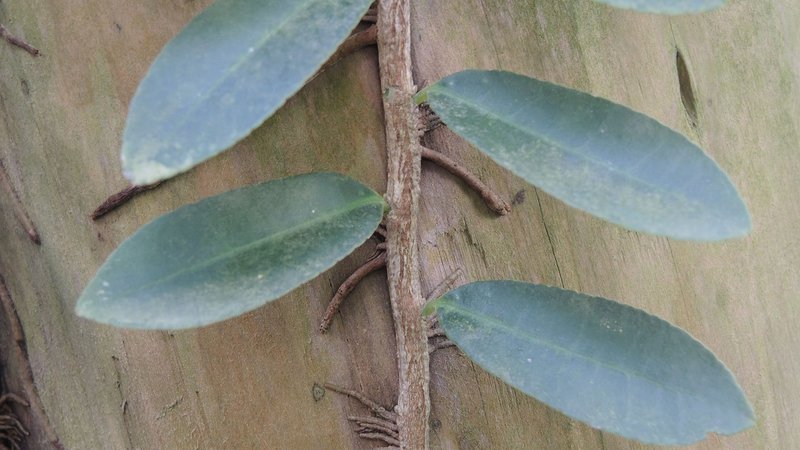
The Marcgravia plant is a climbing epiphyte. This means that it grows on other plants without taking nutrients from them, as parasites do. The epiphyte obtains its nutrients from moisture in the air and from rainfall rather than from the soil, and it uses other plants—especially trees—as a climbing support. This growth habit demonstrates Marcgravia’s fine adaptation to the rainforest, where there is intense competition to reach the light.
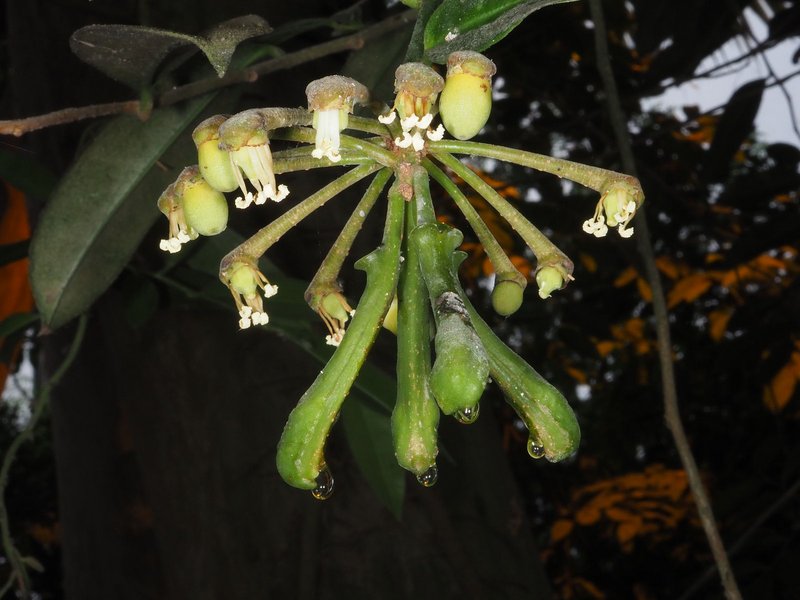
Marcgravia has its flowers arranged in a very special way. The flowers face downward and form a ring around a central cluster of small, nectar-producing cups.
The petals of each individual flower are fused together and form a small cap, which falls off when the flower opens. In this way, the stamens are exposed and can release their pollen.
The nectar in the cups attracts visiting hummingbirds. One theory suggests that while a hummingbird drinks nectar from the small cups, pollen is deposited on the back of its neck, which it then carries to a new flower.
Another theory proposes that the nectar in the cups primarily serves to attract small insects. Birds then come to feed on the insects and in doing so become dusted with pollen, which they transport onward to another flower.
Facts:
- Greenhouse location: Tropical house
- Danish name: Marcgravia
- Latin name: Marcgravia umbellata
- Family: Marcgravia family / Marcgraviaceae
- Natural habitat: South America