Creeping yellowcress
Creeping yellowcress is related to rapeseed, which is commonly seen in fields.

Photo: Jens H. Petersen
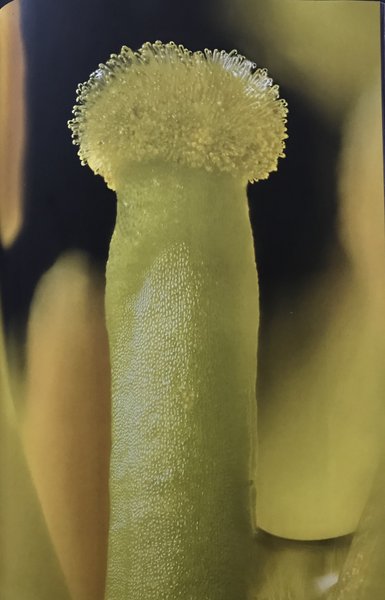
Extreme close‑up of a style with a stigma on top.
Photo: Jens H. Petersen
Creeping yellowcress belongs to the cabbage family like the rapeseed we grow on the fields. Both rapeseed and creeping yellowcress have small yellow flowers with four petals and a large stylus in the center. The fruits are oblong capsules, so-called siliques, with small seeds inside. These and many other features unite them in the cabbage family.
Creeping yellowcress grows in moist and fertile soil along roads and ditches and is often weedy in nurseries and on fields.
Vegetative reproduction is more important for creeping yellowcress than reproduction by seeds. The plant makes underground horizontal stems, or rhizomes. The rhizomes are filamentous, just 1 mm thick, and only a very short piece of rhizome is needed to form a new plant.
When you rake, dig or otherwise cultivate the soil, you make the rhizomes to small bits that may form a new plant – thus multiplying the plant efficiently. All the new plants are genetically identical, they are clones of the mother plant.
Facts:
- Greenhouse location: The exhibition “Fabulous Flowers”
- Danish name: Vej-guldkarse
- Latin name: Rorippa sylvestris
- Family: The mustard family / Brassicaceae
- Natural habitat: On cultivated land and along roads