Pangasinan coelogyne

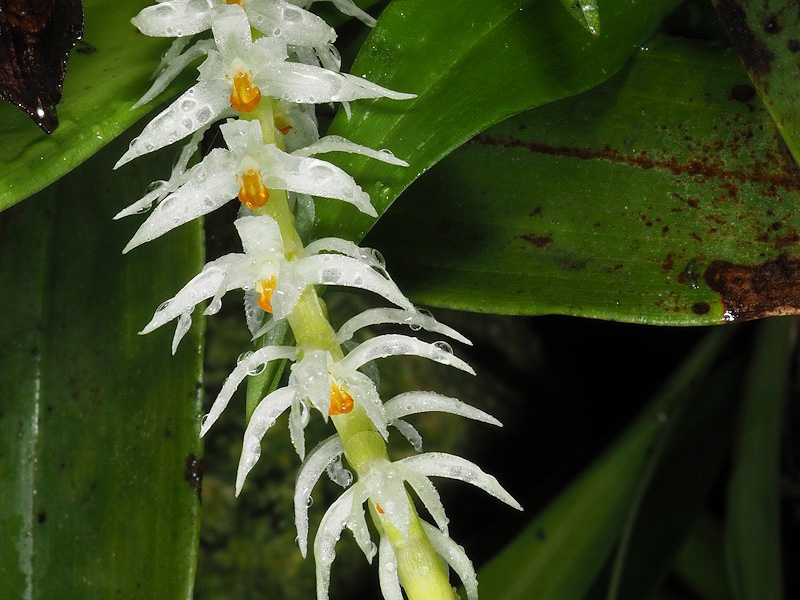
Pangasinan coelogyne (Coelogyne pangasinanensis) grows as an epiphyte in humid rainforests. This means that it grows on branches and in branch forks, often high up in the forest canopy. By growing in these elevated positions, the plants receive much more sunlight than they would on the forest floor.
Where the leaves are attached to the stem, the pangasinan coelogyne develops small, bulb-like swollen stem structures known as pseudobulbs.
Pseudobulbs are found in many orchids, particularly in species that grow on trees or rocks. In these habitats, the plants depend on rainwater and the moisture they can absorb from their surroundings. When rain is scarce, they draw on the reserves of water and nutrients stored in their pseudobulbs. These structures act as the plant’s own emergency supply and are an important adaptation to life high in the tree canopy, where access to water can vary considerably.
The orchid family is among the most species-rich plant families in the world, with around 28,000 known species. The genus Coelogyne is likewise highly diverse and comprises nearly 600 species.
The scientific species name pangasinanensis means “from Pangasinan” and refers to the Philippine province of Pangasinan, where the species was first discovered and described. The name thus tells the story of the plant’s origin and the region in which it was first brought to the attention of science.
Facts:
- Greenhouse location: The Mountain Forest House
- Danish name: Kattehale-orkide
- Latin name: Coelogyne pangasinanensis
- Family: Orchid family / Orchidaceae
- Natural habitat: Philippines