WHO WAS STENO?
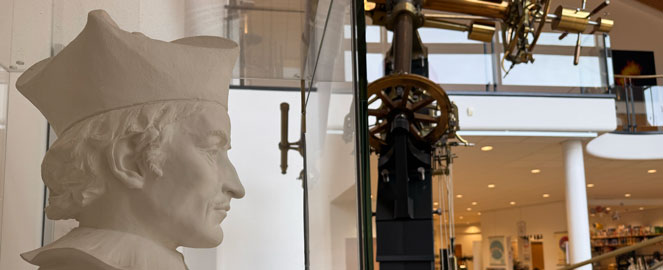
Niels Stensen – The Scientist Who Challenged His Time
Niels Stensen (1638–1686), also known by his Latin name Nicolaus Steno, was one of the most influential scientists of the Renaissance. Through his studies of both the human body and the Earth's structure, he transformed our understanding of nature. His work was based on careful observation and dissection rather than on tradition or speculation.
New Discoveries About the Human Body
While still a medical student, Stensen made a groundbreaking discovery when he identified and described the duct of the parotid salivary gland, now known as the Stensen's duct (ductus stenonianus). His findings disproved the widespread belief that saliva and tears originated in the brain.
During his years in Paris, Stensen continued his anatomical research. He described a congenital heart defect that later became known as Steno-Fallot tetralogy and demonstrated that the heart is simply a muscle that pumps blood throughout the body. This challenged the prevailing seventeenth-century belief that the heart was the seat of emotions and the vital spirits.
In his famous 1666 lecture On the Anatomy of the Brain, Stensen argued that knowledge of the brain should be based on direct observation. He also challenged the French philosopher René Descartes' theory that the soul resided in the pineal gland.
From Anatomy to Geology
In Florence, Stensen combined his anatomical expertise with the study of the Earth. While dissecting a shark, he noticed the striking resemblance between its teeth and the triangular stones known as "tongue stones," which many believed were petrified snake tongues.
Instead, Stensen proposed that these stones were fossilized shark teeth and that they were found in places that had once been covered by the sea. His conclusion that the Earth's surface changes over time was revolutionary at a time when most people believed that God had created the world in its final form.
Science and Faith
Stensen was both a deeply religious man and one of the leading scientists of his age. Later in life he converted to Catholicism, was ordained as a priest, and eventually became a Catholic bishop responsible for Northern Germany, Denmark, and Sweden.
For Stensen, there was no conflict between science and faith. Scientific inquiry was a way of understanding God's creation, and his life illustrates how Renaissance scholars moved freely between natural science, philosophy, and theology.
A Role Model for Scientists
Niels Stensen is remembered not only for his discoveries but also for his scientific approach. He was curious, meticulous, and courageous enough to challenge accepted truths. These qualities continue to make him an inspiring role model for researchers today.