Dark mullein
Impressive medieval medicinal plant found near old monasteries and manor gardens.

Close-up of a young stamen with violet hairs and an orange, still closed anther.
Photo Jens H. Petersen
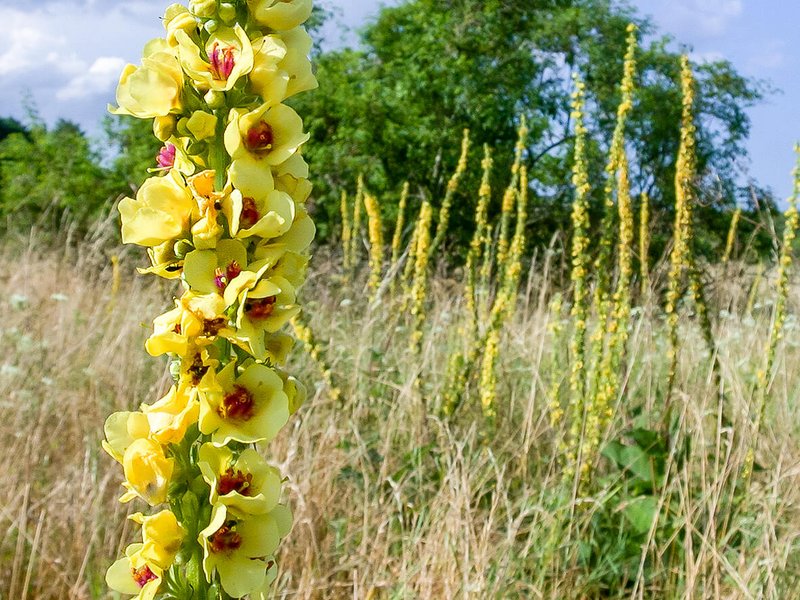
Photo Jens H. Petersen
Dark mullein was introduced to Denmark in the Middle Ages by monks and nuns who cultivated them in the monastery gardens.
It is an ancient medicinal plant, which was, for instance, used against colds, coughs, bronchitis and hoarseness. The impressive inflorescence, dried and dipped in tallow or oil, has been used as a torch.
Dark mullein is a so-called relic plant. Relic plants are to be found at ancient monuments, e.g. court yards at manor houses and monastery ruins. They are the remains of locally grown plants, which in various ways have survived while buildings and gardens have long gone.
Relic plants may survive in different ways. The seeds of dark mullein may survive in the soil for many years without losing the capacity to germinate. When an opportunity eventually arises, they may germinate.
Facts:
- Greenhouse location: The exhibition “Fabulous Flowers”
- Danish name: Mørk kkongelys
- Latin name: Verbascum nigrum
- Family: The figwort family / Scrophulariaceae
- Natural habitat: Along roads, on steep slopes and uncultivated areas.