Narrow-leaved bottlebrush

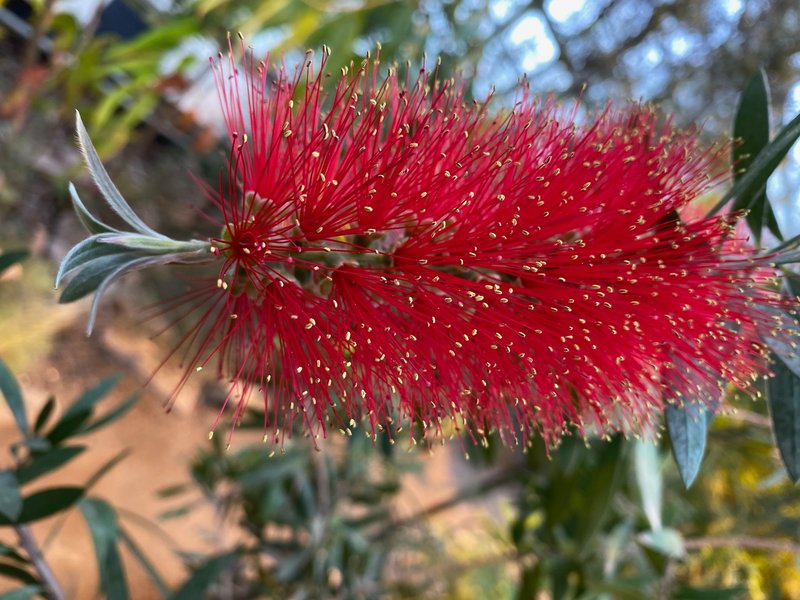
Bottlebrush (Melaleuca) belongs to the myrtle family (Myrtaceae). There are more than 300 species of bottlebrush, most of which originate from Australia, while a few species also occur naturally in Southeast Asia and on islands in the Pacific.
The common name “bottlebrush” is very descriptive, as it is exactly what the cylindrical flower spike resembles. The inflorescence consists of numerous flowers packed closely together. The petals are small and relatively inconspicuous, so what is most visible are the long stamens, which are often red and each bear a small yellow anther at the tip. These bright colours attract both birds and insects, which pollinate the flowers in their natural habitats.
The mature fruits remain attached to the branches, often unopened for several years. A bushfire can trigger the fruits to open and release their many small seeds. Fire can also create favourable conditions for seed germination. Bottlebrush is therefore an example of a plant adapted to regions with frequent wildfires, much like many species of eucalyptus.
Fact box:
- Greenhouse location: Mediteranian house
- Danish name: Flaskerenser
- Latin name: Melaleuca
- Family: Myrtle family / Myrtaceae
- Natural habitat: Australia, Southeast Asia