Date palm

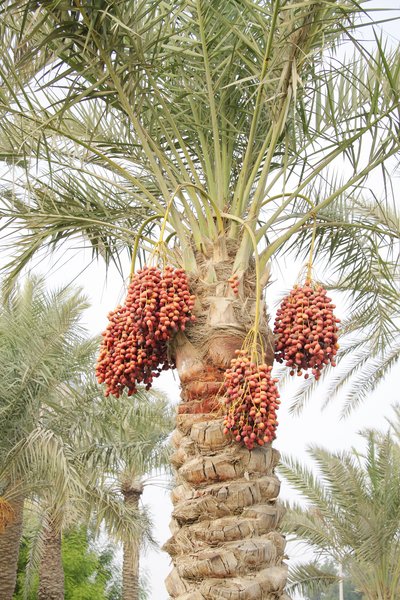
The date palm has been of great importance because it can grow under conditions where many other plants cannot survive. Its sugary fruits, dates, have been an important source of food for people living in the arid regions of North Africa, the Middle East, and the Arabian Peninsula for thousands of years. Dates remain a staple food for many people living in desert environments.
The date palm is believed to have originated in the region around the mouths of the Euphrates and Tigris rivers, in ancient Mesopotamia. Archaeological evidence shows that dates have been cultivated in the Middle East for at least 5,000 years, and possibly as early as 6000 BCE. Dates are mentioned in the Bible, and branches of the date palm were used during Jesus’ entry into Jerusalem on Palm Sunday.
The date palm thrives in hot, dry regions with very little rainfall. It tolerates high temperatures and saline water and soils better than most other crops. At the same time, its roots can reach groundwater, allowing it to be cultivated in oases in the middle of the desert.
Date palms are also highly productive. A single fruit cluster may contain more than 1,000 dates, and a mature palm can produce up to 100 kg of fruit per year. Dried dates contain up to 70-80% sugar and can therefore be stored for long periods without spoiling.
Nearly every part of the date palm can be utilized. The trunk is used as a building material, the leaves provide fibres for roofing and basket weaving, the sap can be used to make syrup or fermented into wine, and above all, the fruit is an important food source and export commodity.
Date palms are dioecious, meaning that male and female flowers are borne on separate trees. It is not possible to determine the sex of a date palm before it flowers, which usually occurs when the tree is about four to five years old. However, only female palms produce fruit, and they require pollen from male palms in order to develop dates.
In a date plantation, one male palm is typically planted for every 50 female palms to ensure successful pollination and fruit production. To maintain this sex ratio, palms are propagated vegetatively through offshoots, making it possible to know in advance whether a newly planted palm will be male or female.
Fact box:
- Greenhouse location: The Dessert House
- Danish name: Daddelpalme
- Latin name: Phoenix dactylifera
- Family: The Palm family / Arecaceae
- Natural habitat: North Africa, the Middle East, and the Arabian Peninsula