A BREAST YOU CAN SIT IN
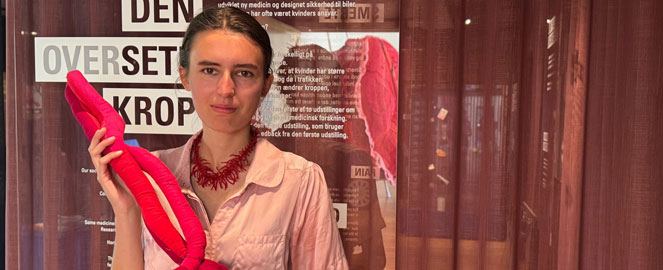
A breast-inspired seat
Scenographer Caroline Bang Hedegaard is behind a large-scale organ installation — a breast furniture piece — which will also function as seating.
What does a piece of furniture look like when it is inspired by the female breast and its inner structures — milk ducts and fatty tissue?
Mammae turns the breast inside out
The breast furniture will be a central part of The Overlooked Body exhibition.
Caroline Bang Hedegaard, based in Aarhus, works at the intersection of scenography and textile art. With her work, Mammae, she aims to make knowledge about the body sensory and tangible:
“With the breast furniture Mammae, I want to transform anatomical knowledge into a bodily and tactile experience that sparks curiosity — while also offering visitors a place to sit and rest.”
The piece visualises the internal structures of the breast — milk ducts, lobules and fatty tissue — using textile techniques.
For Caroline, the project is driven by both fascination and necessity:
“The inner forms of the body are fascinating and strange — like another world we carry just beneath the skin. Knowledge about the body is essential if we are to treat disease properly. That is why it is so important to focus on research into the female body, so women can receive the same quality of medical care as men.”
A tradition of large-scale organs
This is not the first time Science Museerne has worked with oversized organs as an exhibition device.
Currently, the world’s largest knitted placenta is displayed at the entrance to the exhibition. Earlier exhibitions have featured a walk-in uterus as well as large-scale sperm and egg cell models.
Background
When Steno Museet opened The Overlooked Body in January 2025, it marked the first step in a larger exhibition project exploring how the biological female body has historically — and still today — been underrepresented in medical research.
The next exhibition opened on 18 June 2026. It was developed through co-creation between researchers, school students and artists.
The project is supported by the Novo Nordisk Foundation and curated by Science Museerne, Aarhus University, in collaboration with researchers from Aarhus University.