BLOOD, BREASTS AND INEQUALITY
Blood, breasts and blind spots: The overlooked body unfolds in a new exhibition
On 18 June 2026, the Science Museums opened the second phase of the exhibition The Overlooked Body – Blood, Breasts and Inequality at the Steno Museum. Here, medical research, bodily experience and art are woven together in a sensory exhibition that explores what happens when biological female bodies are overlooked in medical research.
This well-documented inequality has had significant consequences for how diseases are detected, understood and treated – and for which organs and symptoms receive attention.
From knowledge to body
The exhibition is grounded in research and translates it into experiential encounters.
A central feature is the large, bodily installations in which the body’s internal structures are made visible on an enlarged scale. Visitors can see – and physically sense – what normally lies hidden beneath the skin.
Objects, real organs and installations are used to make complex conditions comprehensible without reducing them to simplicity. The body is not presented as a single, uniform system, but as something complex, changeable and differing from one person to another.
Mammae turns the breast inside out
One of the most striking works is Mammae, created by textile artist Caroline Bang Hedegaard. It is a large textile breast that functions as a piece of seating furniture, with the idea for the work originating from young workshop participants.
The piece is constructed so that the internal structures are revealed: milk ducts, glandular tissue and layers of fat. Anatomy is made tangible and sensory, and the body appears as something that can both be examined and inhabited.
A giant organ at the centre
At the entrance, visitors encounter a work carried over from the exhibition’s first phase: the world’s largest knitted placenta.
This three-metre installation was created by Australian artist Rebecca Vandyk-Hamilton. It is made from more than 900 recycled T-shirts and was co-created with visitors to the Steno Museum. The knitted placenta hangs as a monument to an organ that is essential to human life and yet still holds many unanswered questions within research.
Positioned at the entrance, the work frames the rest of the exhibition: a physical image of what we have not seen – or have not prioritised understanding.
Read more about the world’s largest knitted placenta
Blood, cycles and overlooked diseases
The exhibition highlights areas of the body and health that are often under-researched. This includes menstruation, where blood – despite its central biological role – is still surrounded by taboo and a lack of knowledge.
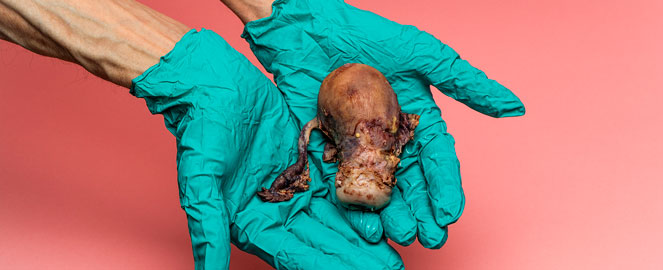
The exhibition unfolds both the biological mechanisms and the human experiences through visual and spatial approaches, including the overlooked disease endometriosis. The personal experience of endometriosis is conveyed through a donor who has given her uterus to the exhibition and who tells her story as part of it.
Read more about the donor
Anxiety as material
Co-creation is a recurring theme throughout the exhibition. This is evident, for example, in a work about anxiety created by pupils from Aarhus Efterskole in collaboration with artists.
Through embroidery, the pupils worked with anxiety as a bodily and sensory phenomenon alongside artists Amanda Kessaris and Ida Fonslet. The individual contributions consist of textile images and symbols, which form an immersive installation that visitors can enter and experience.
The slow process of working with needle and thread also functioned as a way of exploring and expressing something that can otherwise be difficult to put into words. The result is a work in which many different experiences coexist side by side – without being brought together into a single explanation.
An exhibition in motion
The Overlooked Body has been developed in two phases. The first phase introduced the issue through concrete cases and an open workshop environment, where artists, visiting researchers and pupils could meet to select and develop content for the next exhibition.
The second phase is the result of extensive work with co-creation. New works, new perspectives and new experiences have been integrated into a larger, shared whole.
As a result, the exhibition does not appear as a finished narrative, but as a space for reflection and investigation. It points to the blind spots that still exist in our understanding of the body – and reveals ways of making them visible.
The Overlooked Body – Blood, Breasts and Inequality has been developed in collaboration with researchers from Aarhus University and Aarhus University Hospital together with pupils and artists.
The Overlooked Body is supported by the Novo Nordisk Foundation.