YOUNG PEOPLE CO-CREATE ARTWORK ABOUT ANXIETY
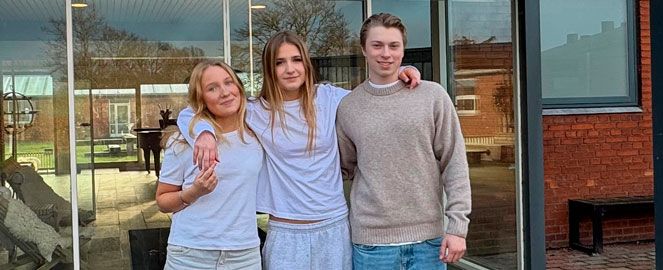
What happens when young people with no prior experience in embroidery are invited into a professional exhibition setting — and at the same time asked to engage with a difficult topic such as anxiety?
This is the question explored by a 10th-grade class from Aarhus Efterskole through a co-creation project for the exhibition The Overlooked Body.
Through four workshops, and in collaboration with museum professionals and two artists, the students have worked with the theme of anxiety. The process has resulted in 24 personal contributions to what will become a collective artwork and a central element in the upcoming exhibition: a youth perspective on a topic that is still underexplored — also in medical research.
“Oh no, embroidery”
For students Conrad Freddy Kruse and Wenche Meisin Set Högling, embroidery was not something they had any prior experience with — quite the opposite.
“It was more of an ‘Oh no’ feeling when we were told we had to do embroidery,” Conrad explains. “But once I started, it was actually okay.”
Conrad chose to embroider a hand — a motif that, for him, came to represent reaching out and perhaps stepping outside his comfort zone. A simple symbol, but with many possible layers.
Wenche chose a different direction:
“I chose to make a fish,” she says. “I was thinking about loneliness when I made it. Maybe it was a small fish in the big ocean.”
Both experienced that working with their hands created space for reflection — also on a subject that can be difficult to put into words.
The mask we show the world
Anna Fenger Kangas, also a 10th-grade student at Aarhus Efterskole, had previous experience with embroidery and therefore did not face the same barrier in relation to the craft itself. She chose to embroider a face — a mask.
“It was probably about how you can hide your feelings behind a mask,” she explains.
The motif points to a familiar experience for many young people: that what you show on the outside does not necessarily match what you feel on the inside.
More than a creative project
All three students emphasise that it has been a great experience to take part — not just as participants, but as co-creators. Anna notes that it could be interesting to have even more responsibility and influence on the outcome.
For example, she suggests that young people could be involved in choosing the creative forms of expression, rather than having them predefined — and also in shaping the final artwork.
At the same time, the co-creation project has given all three a greater understanding of anxiety — and of how personal experiences can become part of a professional exhibition context.
What comes next?
If the students were to work with a new topic in a similar framework, they already have ideas.
Anna and Wenche point to the female cycle as an overlooked and “very exciting” theme, while Conrad would like to explore social media and its influence on how we see ourselves and each other.
Their contributions to The Overlooked Body demonstrate how textile techniques, personal narratives and co-creation can open up new perspectives — both on anxiety and on the blind spots that still exist in our understanding of body and mind.
Above all, the students have helped create a space for communication and reflection that also resonates with a younger audience.